Avoid liquidated Damages: EOT Claims QLD Guide for Builders
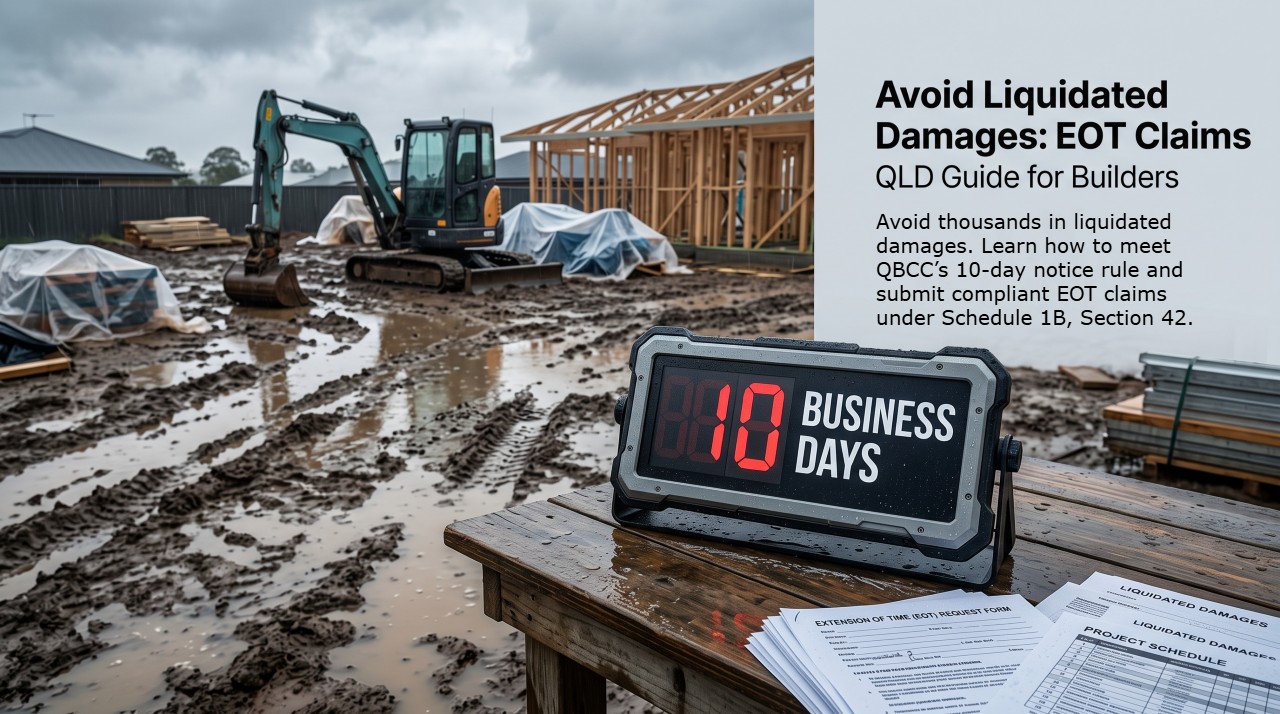
The site reality vs the contractual clock
You know the feeling of standing on a site in your steel-caps, watching a trench turn into a swimming pool after a standard Queensland downpour. Or staring at an empty loading bay because your materials are stuck in a supply chain bottleneck that nobody predicted six months ago.
In the high-stakes world of QLD construction, these aren’t just daily headaches – they are direct threats to your project’s profit margin. Every day your build runs past the completion date, you aren't just losing time; you are essentially paying out of your own pocket to stay on site.
Extension of Time (EOT) claims are often viewed as "just more paperwork," but that is a dangerous misconception. In reality, an EOT is your primary legal shield under Queensland law. It is designed to protect your hard-earned margin against external forces like extreme weather, late client approvals and material surges.
The clock is always ticking against the builder. If you aren't actively managing the calendar, the contract will eventually be used as a weapon against your cash flow. Before signing any agreement, ensuring your contract includes tailored special conditions – via a builder contract review service – is your first defence against delay penalties.
If you miss a statutory or contractual notice window, the law rarely cares how hard you worked or how much it rained.
The financial stakes: Why delayed EOT notices expose builders to liquidated damages
Liquidated damages (LDs) are the silent killer of construction businesses across Queensland. They represent a pre-agreed daily financial penalty charged for every day the project runs past the Date for Practical Completion without a valid extension. While many standard residential building contracts default to $50 per day, commercial projects or customized contracts can set LDs at $500 to over $1,000 per day.
- The margin math: On a project running over by just 14 days at $500/day, that is $7,000 wiped straight off your final claim before packing up your tools. For a builder operating on a tight margin, an unexcused delay doesn't just hurt – it can completely vaporise your profit for that stage.
- The payment offset trap: Under Queensland's Building Industry Fairness (Security of Payment) Act 2017 (BIF Act), if you haven't secured a valid EOT, the principal or homeowner can legally offset these LDs directly against your progress claim in their Payment Schedule. They don't have to sue you first; they simply deduct the penalty from what they owe you.
Read our deep dive on what are liquidated damages and how are they different to unliquidated damages to see how severe these penalties get. To keep the LD meter from running, you must identify a qualifying delay and serve your notice before the window slams shut.
Qualifying delay events under QLD standard contracts
Under Queensland law and standard contract regimes (such as AS 4000, AS 4902, AS 2124, HIA, and Master Builders), delays are split between "builder's risk" and "qualifying delays". Management issues – like a subbie calling in sick or forgetting to order materials on time – are not qualifying delays.
A qualifying delay must be an excusable event beyond your reasonable control. To win an EOT, your claim must fall into one of these recognized categories:
- Inclement weather & site inaccessibility: Heavy rain, cyclones and severe weather events common to Queensland’s climate. This includes "residual" wet weather days – the time the ground remains a bogged mud-pit preventing machinery or trades from safely working.
- Latent site conditions: Discovering unexpected underground utilities, poor soil quality, rock formations or unmapped contamination that wasn't reasonably apparent during pre-contract site inspections.
- Principal / owner-caused delays: Late delivery of owner-supplied materials, failure to grant site access, delayed progress payments or taking weeks to select finishes or approve variations.
- Council & certifier approvals: Delays in obtaining mandatory statutory permits, inspections or council sign-offs through no fault of the builder.
- Client-requested variations: Scope changes requested by the building owner. Under Queensland law, every contract variation must be assessed for its impact on the critical path schedule.
Crucial rule: These events do not automatically extend your contract date. Even if the site is underwater for a month, your Date for Practical Completion stays exactly where it is until you serve a formal, compliant EOT notice.
The statutory notice rule: S42 schedule 1B QBCC Act & Contract Time Bars
The biggest trap for Queensland builders is assuming that verbal updates or site meeting chats count as a delay claim. They do not.
For regulated residential construction contracts in Queensland, the EOT process is governed directly by Section 42 of Schedule 1B of the Queensland Building and Construction Commission Act 1991 (QBCC Act). Under Section 42:
- The claim must be made in writing.
- The claim must be given to the building owner within 10 business days of the contractor becoming aware (or when they reasonably ought to have become aware) of the cause and extent of the delay.
- The contractor cannot legally rely on an EOT unless claimed in strict compliance with these statutory steps.
Commercial contracts (such as modified AS 4000 or AS 2124 agreements) often contain even stricter contractual "Time Bars" (ranging from 2 to 28 days). Courts treat these time bars as a condition precedent to your right to extra time. If you miss the window, your right to claim extra time is legally extinguished.
The compliance countdown: A builder’s 10-business-day window
Missed the notice window? Legal defences & strategies
If admin paperwork fell to the bottom of the pile during a chaotic build and you missed your notice window, don't panic immediately. While contract time bars are strict, specialised construction law provides pathways that may defend your margin:
- The prevention principle: Under Australian construction law (established in landmark cases like Peak Construction), a principal cannot enforce liquidated damages for a delay that they themselves caused. If the owner delayed the project (eg. late site access or design hold-ups), the Prevention Principle may set time "at large," meaning you are only required to complete the project within a reasonable time rather than the original contract date.
- Superintendent’s unilateral discretion: In contracts using standard form frameworks (like AS 2124 or AS 4000), the superintendent may hold a discretionary power to grant an EOT even if formal notice was late. Case precedent (Peninsula Balmain v Abigroup) establishes that contract administrators must exercise certain discretionary powers honestly and impartially.
- Commercial variation reset: When an owner requests new variations later in the project, an experienced legal strategist can negotiate a reset of the Date for Practical Completion as a condition of agreeing to the new scope of work.
These defences are complex and require senior legal navigation, but they prove that a missed notice doesn't automatically mean you must accept liquidated damages without a fight.
Step-by-step: How to write & serve a compliant EOT claim
Step 1: Capture contemporaneous site evidence
The moment work stops, document the delay. Take date-stamped photos of bogged site conditions, log local weather bureau reports, and save supplier delivery delay notices. Verbal explanations are legally insufficient.
Step 2: Prove critical path causation
You are only entitled to an EOT if the delay impacts the project’s Critical Path – the sequence of linked tasks that directly dictates the final handover date.
Example: Rain stopping outdoor earthworks for 3 days while your trades are working inside on joinery may not support an EOT if earthworks isn't currently controlling the handover date. You must prove the delay event pushed out the overall project schedule.
Step 3: Serve the formal written notice
Ensure your EOT claim includes:
- The precise cause of delay (eg. S42 QBCC Act / Clause 34 AS4000).
- The start date and estimated duration of the delay.
- Proof of critical path impact.
- The exact number of extended days requested.
CSA members can access pre-drafted, compliant EOT notice templates directly from their online member legal dashboard.
Legal precedent: Why QLD courts enforce strict delay rules
Queensland courts and tribunals (QCAT) strictly enforce contract terms and statutory notice provisions.
- State of Queensland v Multiplex Constructions (1999): The QLD Full Court confirmed that notice requirements specifying claims must be made "after the delay occurs" mean within the set timeframe of when the delay first begins, not after the entire delay has finished. Delaying your notice until the end of a wet weather period can invalidate your entire claim.
- Addinos Pty Ltd v OJ Pippin Homes Pty Ltd (2022 QDC 205): Demonstrates the severe consequences for QLD residential builders who fail to follow contract notice mechanics. Administrative failures to issue formal notices expose builders to enforceable liquidated damages.
- Growthbuilt Pty Ltd v Modern Touch Marble (2021 NSWSC 290): Highlighted that where contracts explicitly give a principal "absolute discretion" to extend time, courts will not imply an obligation to grant late EOTs, making strict notice compliance vital.
A judge will not rescue a builder from a missed contractual or statutory deadline. "We'll sort it out at the end" remains one of the most expensive assumptions in construction.
Fixed-fee protection: Preserving your project margins
Many builders hesitate to call a lawyer due to fear of unpredictable hourly billing. Calling for a 10-minute question only to receive an unexpected bill for hundreds of dollars causes contractors to "wing it" – often leading to thousands lost in rejected claims.
ConstructSupport Australia (CSA) operates on a transparent fixed-fee model backed by senior construction solicitors at RA Law Group. We replace unpredictable hourly billing with clear, budgeted legal protection.
As a CSA member, your business gets:
- 100% upfront fixed pricing: Complete transparency with zero surprise legal bills.
- 1-business-day callback guarantee: Direct access to experienced construction lawyers when site emergencies hit.
- Proactive contract audits: Custom special conditions inserted into your contracts (cost escalation, provisional sums and fair EOT terms) before work starts.
- 50% discounted litigation backup: Full representation from RA Law Group at a guaranteed 50% rate discount if formal court proceedings occur.
Frequently Asked Questions about QLD EOT claims
Does a text message or phone call count as a valid EOT notice?
Almost certainly not. QLD standard contracts and S42 of Schedule 1B of the QBCC Act require formal notice in writing served via authorised methods (typically email or registered mail). Informal texts are easily challenged and often rejected in adjudications.
Can I claim an EOT for rain if the site wasn't under water, but trades couldn't access it?
Yes. Inclement weather covers both active rainfall and residual site conditions (eg. saturated ground or flooded access roads) that make site operations unsafe or impractical. Ensure you retain site photos and Bureau of Meteorology reports as evidence.
What if the principal refuses to approve a valid EOT claim?
If an owner wrongfully rejects a valid EOT, you can lodge a dispute through the QBCC accelerated mediation framework or escalate to QCAT/adjudication under the BIF Act to protect your progress claims from unlawful LD deductions.
Are legal retainer fees tax-deductible for my construction business?
Yes. Under Section 8-1 of the Income Tax Assessment Act 1997, legal fees and ongoing subscription retainers incurred in protecting day-to-day business operations, enforcing contracts and recovering progress payments are generally fully tax-deductible.
Protect your project profit.
Don't let rain delays or slow client responses wipe out your hard-earned margin.
Book your free 15-minute risk consult today – it takes 30 seconds and protects your next job from a liquidated damages disaster.